
Introduction
Every business needs to pay its employees on time. Whether it is a small retail store, restaurant, marketing agency, construction company, or online business, managing employee salaries is an essential part of daily operations.
However, many small businesses do not have dedicated HR departments or experienced payroll professionals. They often struggle with calculating employee salaries, managing deductions, preparing payslips, tracking working hours, and maintaining payroll records.
This creates an excellent business opportunity for people who want to earn money by providing Payroll Services for Small Businesses.
Payroll services help companies manage employee payments, salary calculations, tax-related records, deductions, and payroll reports. Instead of hiring a full-time payroll employee, small businesses can outsource these tasks to independent professionals or payroll service providers.
The good news is that you do not necessarily need to establish a large company to enter this industry. You can start as a freelancer, offer payroll management services remotely, become a payroll software consultant, or build your own payroll outsourcing agency.
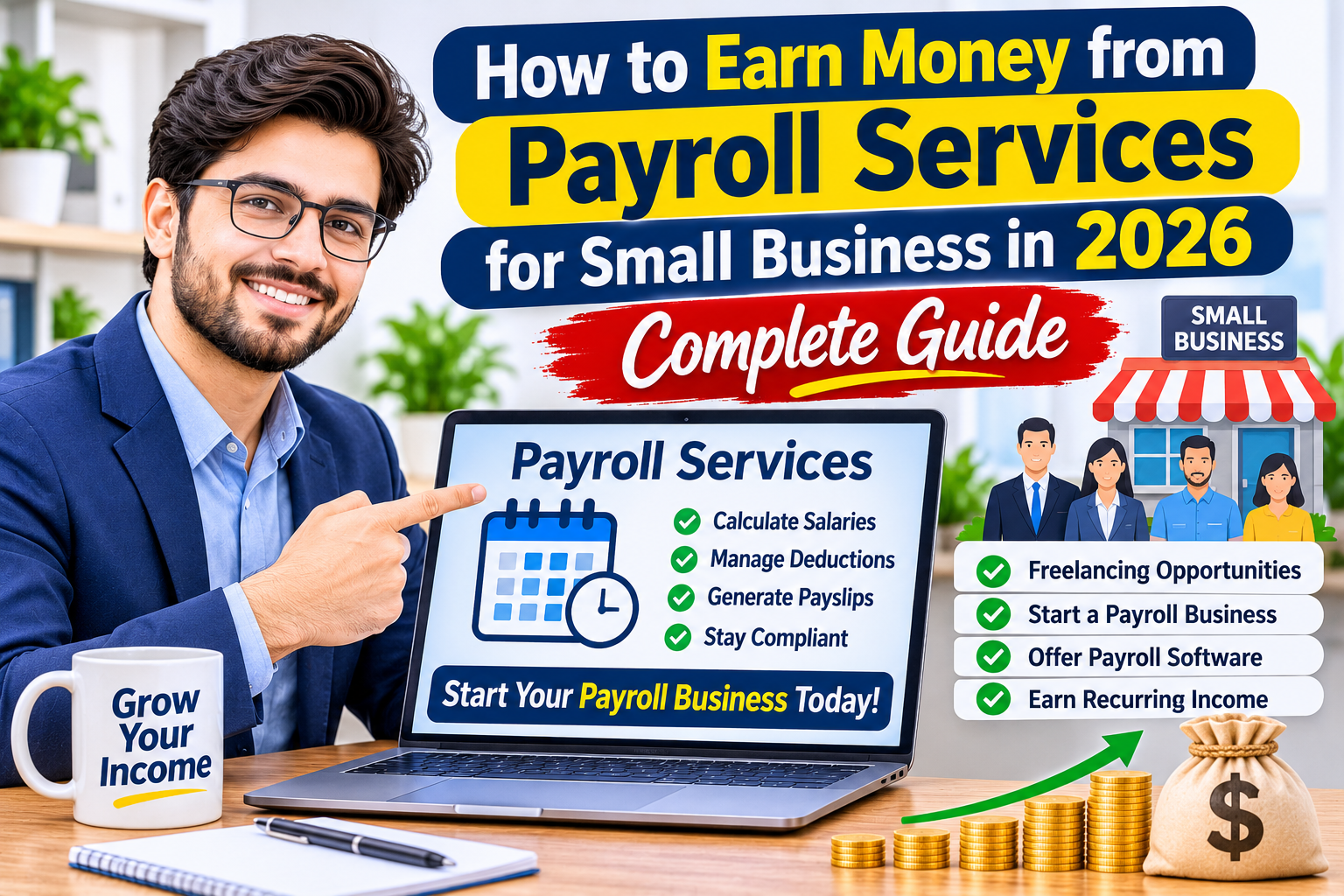
In this complete guide, we will explain how to earn money from payroll services for small businesses, which services you can offer, the best payroll software platforms, how to find clients, and how to build a profitable payroll services business in 2026.
What Are Payroll Services for Small Businesses?
Payroll services are professional solutions that help businesses calculate, manage, and process employee payments.
A payroll service provider handles different administrative tasks related to employee compensation. These services can be delivered manually, through payroll software, or using a combination of both.
Common payroll services include:
- Employee salary calculations
- Monthly payroll processing
- Payslip generation
- Overtime calculations
- Employee attendance tracking
- Tax withholding calculations
- Employee deductions management
- Payroll record maintenance
- Payroll reports and documentation
- Direct deposit administration
For example, imagine a small company with 15 employees. The business owner must calculate monthly salaries, manage deductions, prepare payslips, and maintain payment records.
Instead of spending several hours every month handling these responsibilities, the owner can hire an external payroll service provider.
This is where you can offer your services and earn money.
How to Earn Money from Payroll Services for Small Businesses
There are several ways to generate income in the payroll industry. You can provide payroll processing directly, work as a freelancer, help businesses implement payroll software, or create a subscription-based payroll service.
Let’s explore the most practical opportunities.
1. Start a Payroll Processing Business
Starting a payroll processing business is one of the most direct ways to earn money from payroll services.
Your business will manage salary calculations and payroll administration for small companies that do not want to handle these responsibilities internally.
You can offer services such as:
- Monthly salary processing
- Employee payment calculations
- Payslip preparation
- Overtime calculations
- Bonus and commission calculations
- Employee deduction records
- Payroll summaries
- Monthly payroll reports
For example, a small marketing agency may have 10 employees and need someone to prepare monthly payroll reports.
You can provide this service for a monthly fee.
As your client base increases, you can hire additional payroll assistants and expand your business.
How to Start
- Learn basic payroll calculations and payroll regulations.
- Choose suitable payroll software.
- Create service packages for small businesses.
- Build a professional website.
- Contact local companies and startups.
- Offer a free initial consultation.
- Convert interested businesses into monthly clients.
The biggest advantage of this model is the opportunity to generate recurring monthly revenue.
2. Offer Freelance Payroll Services
You do not need to establish a complete payroll company to start earning money.
Freelancing allows you to provide payroll-related administrative services to businesses from home.
Many small companies look for remote professionals who can help organize employee salary information, prepare payroll spreadsheets, generate payslips, and maintain payroll records.
Some freelance services include:
- Payroll data entry
- Salary calculations
- Payslip creation
- Employee information management
- Payroll spreadsheet preparation
- Attendance and overtime tracking
- Payroll software administration
- Monthly payroll reporting
You can find potential clients through platforms such as Upwork, Fiverr, and Freelancer.
Skills You Should Learn
To become a successful freelance payroll professional, develop these skills:
- Microsoft Excel
- Google Sheets
- Payroll calculations
- Basic accounting
- Employee record management
- Payroll software operation
- Attention to detail
- Data confidentiality
You can begin with simple administrative tasks and gradually move toward more advanced payroll services.
Important: Payroll tax filings, legal compliance work, and regulated accounting services may require specific qualifications or authorization depending on the country. Only offer services you are competent and legally permitted to provide.
3. Earn Money by Offering Payroll Software Setup Services
Many small businesses purchase payroll software but do not know how to configure it properly.
This creates an opportunity to become a payroll software setup specialist.
You can help companies select, configure, and start using payroll management platforms.
Your services may include:
- Creating payroll software accounts
- Adding employee information
- Configuring salary structures
- Setting up pay schedules
- Creating employee categories
- Configuring leave and overtime rules
- Setting up payroll reports
- Training business owners and employees
For example, a small business may purchase payroll software but struggle to transfer its employee information from spreadsheets.
You can charge a setup fee to organize the information and configure the system.
You can also offer ongoing support for businesses that need help managing their payroll software.
4. Become a Payroll Software Consultant
Payroll software consulting is another potential income opportunity.
Small businesses often need help selecting the right payroll platform because different software solutions offer different features, pricing plans, and integrations.
As a consultant, you can help businesses understand their requirements and choose suitable payroll software.
Your consulting services can include:
- Payroll software comparisons
- Software recommendations
- Payroll workflow evaluation
- Payroll system implementation
- Employee data migration
- Payroll automation
- Software training
- Ongoing technical support
You can charge a fixed consultation fee or provide monthly support packages.
To become a consultant, learn how different payroll systems work and understand the needs of different industries.
5. Start a Payroll Outsourcing Agency
If you want to build a larger business, consider launching a payroll outsourcing agency.
Instead of providing services to only one or two clients, your agency can manage payroll administration for multiple small businesses.
You can target:
- Restaurants
- Retail stores
- Construction companies
- Marketing agencies
- Online businesses
- Healthcare offices
- Small manufacturing companies
- Professional service providers
Your agency can offer different service packages depending on employee numbers and business requirements.
For example, one client may need basic monthly payroll calculations, while another may require payslips, employee record management, and payroll reporting.
You can build a team of trained payroll administrators as your business grows.
6. Make Money Through Payroll Software Affiliate Marketing
If you own a blog, YouTube channel, or business website, payroll software affiliate marketing can create another source of income.
Many businesses search online for payroll software before choosing a solution.
You can publish helpful articles reviewing different payroll platforms and include affiliate links where eligible programs are available.
When a visitor purchases a qualifying subscription through your referral link, you may earn a commission according to the provider’s affiliate terms.
Payroll Software Brands to Research
- Gusto
- QuickBooks Payroll
- ADP
- Paychex
- Rippling
- OnPay
- Deel
Check each company’s current affiliate or partner program availability, eligible countries, commission structure, and payment conditions. Not every provider offers a public affiliate program.
Best Blog Topics for Payroll Affiliate Marketing
You can target keywords such as:
- Best Payroll Software for Small Business
- Cheapest Payroll Software for Small Businesses
- Best Payroll Software for Startups
- Gusto vs QuickBooks Payroll
- Best Automated Payroll Systems
- Payroll Software with Direct Deposit
- Best Payroll Software for Remote Employees
- How to Choose Payroll Software for a Small Business
These topics attract people who are researching payroll solutions for their companies.
7. Provide Payroll Tax and Compliance Support
Payroll tax administration is another important area of the payroll industry.
Businesses must follow applicable payroll tax regulations, maintain accurate records, and submit required information to the relevant authorities.
Depending on your qualifications and local laws, you may be able to provide administrative support such as:
- Organizing payroll tax records
- Preparing payroll summaries
- Maintaining employee deduction records
- Tracking payroll deadlines
- Organizing tax-related documents
- Supporting authorized accountants with payroll information
Companies operating in different countries may have different payroll tax requirements.
For example, US employers have federal and state payroll obligations, while businesses in the UK, Canada, Australia, and Pakistan follow their own tax and employment regulations.
If you are not qualified to provide tax or legal advice, work with licensed accountants or authorized professionals for those responsibilities.
8. Offer Payroll Data Entry and Payslip Creation
This is a relatively accessible starting point for beginners.
Many small businesses maintain employee salary records using Excel spreadsheets or basic accounting software.
You can help them organize their payroll information and create professional payslips.
Your services may include:
- Employee salary data entry
- Basic salary calculations
- Allowance records
- Overtime tracking
- Deduction summaries
- Monthly payslip generation
- Payroll spreadsheet formatting
You can create reusable spreadsheet templates to save time.
However, always verify calculations with the client’s approved salary rules and applicable employment regulations.
9. Build Your Own Online Payroll Software Business
If you have programming knowledge or access to a development team, you can develop your own payroll management platform.
A cloud-based payroll system can help small businesses manage their employee payments from one centralized dashboard.
Potential features include:
- Employee management
- Salary calculation
- Payslip generation
- Attendance management
- Leave tracking
- Overtime calculations
- Payroll reports
- Employee self-service portals
- Secure document storage
You can monetize the software using a Software-as-a-Service (SaaS) subscription model.
For example, you could create:
Starter Plan: Basic employee records and payslip generation.
Professional Plan: Payroll processing, attendance tracking, and reporting.
Business Plan: Advanced payroll automation, employee self-service, and integrations.
Enterprise Plan: Custom workflows, advanced permissions, and dedicated support.
This approach requires software development, security testing, regulatory research, and ongoing maintenance. Payroll data is sensitive, so strong privacy and security controls are essential.
10. Provide Payroll Training and Online Courses
Another way to generate income is by teaching people how to use payroll software.
Small business owners, administrative assistants, HR employees, and beginners may want to learn payroll management.
You can create online courses covering:
- Payroll management fundamentals
- Employee salary calculations
- Microsoft Excel for payroll
- Payslip preparation
- Payroll software tutorials
- Employee record management
- Payroll reporting
- Payroll administration basics
You can sell courses through your own website or educational marketplaces.
You can also provide one-to-one training sessions through Zoom or other online meeting platforms.
Best Payroll Software for Small Businesses in 2026
Choosing the right payroll software is important if you want to provide professional payroll services.
Here are some popular platforms worth exploring.
1. Gusto
Gusto is a payroll and HR platform designed primarily for US businesses. It offers payroll processing, employee benefits administration, and HR-related features.
It is worth exploring if you want to work with small businesses that need integrated payroll and HR solutions.
2. QuickBooks Payroll
QuickBooks Payroll is designed to help businesses manage payroll alongside accounting activities.
It can be useful for businesses that already use QuickBooks accounting products.
3. ADP
ADP provides payroll, HR, and workforce management solutions for businesses of different sizes.
It is a well-established platform for companies looking for payroll services and related business tools.
4. Paychex
Paychex offers payroll processing and HR solutions, including services designed for small and medium-sized businesses.
5. OnPay
OnPay provides payroll and HR features for eligible businesses, particularly those looking for payroll administration in the US market.
6. Deel
Deel offers global payroll and workforce management solutions for businesses working with international employees and contractors.
Important: Software availability, pricing, and features vary by country. Always verify regional support and current product terms before recommending a platform to a client.
How Much Money Can You Earn from Payroll Services?
Your income depends on the number of clients, employees managed, services offered, pricing structure, and operating costs.
You can earn through:
| Payroll Business Model | How You Earn |
|---|---|
| Payroll processing | Monthly service fees |
| Freelancing | Hourly or project-based payments |
| Software setup | One-time setup fees |
| Payroll consulting | Consultation fees |
| Payroll outsourcing | Recurring client contracts |
| Affiliate marketing | Eligible referral commissions |
| Online training | Course and session sales |
| Payroll SaaS | Monthly or annual subscriptions |
Example: Monthly Payroll Service Revenue
Suppose you start a small payroll service business and attract five clients.
Each client pays you $100 per month for basic payroll administration.
Your monthly revenue would be:
5 clients × $100 = $500 per month.
If you eventually increase your client base to 20 businesses:
20 clients × $100 = $2,000 per month.
These are hypothetical examples, not guaranteed earnings or verified industry rates. Actual revenue will depend on the complexity of payroll, employee count, client location, and your costs.
How to Find Small Business Payroll Clients
Finding paying clients is one of the most important parts of building a successful payroll services business.
Here are some practical methods.
1. Use LinkedIn
Create a professional LinkedIn profile describing your payroll services.
Connect with:
- Small business owners
- Startup founders
- HR managers
- Accounting firms
- Restaurant owners
- Retail business managers
Share useful payroll tips and explain how outsourcing can save businesses time.
2. Create a Professional Website
Your website should clearly explain the payroll services you offer.
Include dedicated pages for:
- Payroll Processing
- Payroll Software Setup
- Payslip Generation
- Payroll Administration
- Payroll Outsourcing
- Contact Information
Publish useful articles to attract organic search traffic.
3. Join Freelance Marketplaces
Create profiles on Upwork, Fiverr, and Freelancer.
Use relevant service descriptions such as:
- I will manage your monthly payroll records.
- I will create professional employee payslips.
- I will organize your payroll spreadsheets.
- I will help configure payroll software.
- I will provide payroll administrative support.
Clearly explain your experience, software skills, and service limitations.
4. Contact Local Small Businesses
Reach out to small companies that may need assistance with employee payroll.
Introduce your services professionally and explain how you can help them organize salary calculations and employee records.
5. Build Partnerships with Accountants
Accounting firms may need additional payroll administration support for their clients.
You can build professional relationships with accountants and offer authorized back-office support.
Step-by-Step Guide to Starting a Payroll Services Business
If you are new to this industry, follow this practical roadmap.
Step 1: Learn Payroll Fundamentals
Understand salary structures, employee deductions, overtime, payslips, payroll records, and relevant employment regulations.
Step 2: Learn Microsoft Excel
Excel is useful for organizing employee records and performing basic payroll calculations.
Step 3: Learn Payroll Software
Explore platforms such as QuickBooks Payroll, Gusto, ADP, and other systems that serve your target market.
Step 4: Choose Your Target Market
Decide whether you want to work with startups, retail businesses, restaurants, agencies, or international clients.
Step 5: Create Service Packages
Start with clearly defined services such as payroll data organization, payslip preparation, and monthly payroll administration.
Step 6: Build Your Online Presence
Create a website, professional email address, and LinkedIn profile.
Step 7: Find Your First Clients
Use freelance platforms, business networking, and direct outreach.
Step 8: Deliver Accurate and Secure Services
Use approved payroll information, verify calculations, protect employee data, and maintain clear records.
Step 9: Expand Your Business
Once you have regular clients, introduce payroll software implementation, automation, training, and ongoing support services.
Can You Start a Payroll Services Business from Home?
Yes. Many payroll administration activities can be performed remotely.
You generally need:
- A computer or laptop
- Reliable internet access
- Microsoft Excel or Google Sheets
- Suitable payroll software
- Basic accounting knowledge
- Secure document storage
- Professional communication skills
You can work with clients in your local market or target international businesses, provided you understand the relevant payroll rules and are legally permitted to provide the services.
For example, a freelancer based in Pakistan may offer payroll data management or administrative support to an overseas business. However, handling payroll tax filings or regulated services may require additional qualifications, authorization, or local professional support.
Advantages of Starting a Payroll Services Business
There are several reasons why payroll services can be an attractive business opportunity.
- Recurring income: Many clients need payroll support every month.
- Remote work: Many administrative payroll tasks can be completed online.
- Business demand: Companies need reliable employee payment administration.
- Multiple revenue streams: You can combine consulting, software setup, outsourcing, and training.
- Scalability: You can hire trained staff and manage additional clients as your business grows.
- Low initial infrastructure requirements: You can start with a computer, internet connection, appropriate software, and professional skills.
Challenges of Running a Payroll Services Business
Although payroll services can provide attractive business opportunities, there are important challenges to consider.
- Payroll mistakes can affect employee salaries.
- Tax and employment regulations vary by country.
- Employee payroll information is highly confidential.
- Software subscriptions may increase operating costs.
- Clients expect accurate and timely payroll processing.
- You need to stay updated with regulatory changes.
- Some payroll services require professional qualifications or authorization.
To build a trustworthy business, use secure systems, maintain accurate records, and establish clear agreements with your clients.
Frequently Asked Questions (FAQs)
1. Can I earn money by providing payroll services to small businesses?
Yes. You can earn money by offering monthly payroll processing, payslip creation, employee record management, payroll software setup, and other administrative services.
2. How much does a payroll service provider charge?
Pricing depends on the number of employees, payroll frequency, complexity, location, and services included. Providers may charge a monthly fee, per-employee fee, or a combination of both.
3. Can beginners start a payroll services business?
Yes. Beginners can learn payroll fundamentals, Excel, and payroll software before offering basic administrative services. Start with tasks that match your skills and qualifications.
4. Do I need a degree to provide payroll services?
Not every payroll administrative task requires a university degree. However, professional certifications, accounting knowledge, and relevant experience can improve your credibility. Regulated services may require specific qualifications.
5. Which payroll software is best for small businesses?
Popular options include Gusto, QuickBooks Payroll, ADP, Paychex, and OnPay. The best choice depends on business size, country, budget, and payroll requirements.
6. Can I provide payroll services from home?
Yes. You can manage many payroll administration tasks remotely using secure software, spreadsheets, and online communication tools.
7. Is payroll outsourcing profitable?
Payroll outsourcing can generate recurring revenue because businesses typically need payroll services regularly. Profitability depends on pricing, client retention, operational costs, accuracy, and compliance.
8. How can I get my first payroll client?
Start by creating a professional portfolio, joining freelance marketplaces, connecting with small business owners on LinkedIn, and approaching local companies that need payroll assistance.
Conclusion
Payroll services for small businesses offer an interesting opportunity for freelancers, entrepreneurs, accountants, and digital business owners.
Companies need reliable ways to manage employee salaries, payslips, deductions, and payroll records. By providing these services, you can build a business that generates recurring monthly revenue.
You can start as a freelance payroll administrator, become a payroll software consultant, offer payroll outsourcing, promote payroll software through affiliate marketing, or eventually develop your own payroll platform.
The best approach is to learn the fundamentals, choose a specific service, develop your software skills, and build relationships with small business owners.
With the right knowledge, reliable service, and a strong client acquisition strategy, payroll services can become a sustainable online business opportunity in 2026.